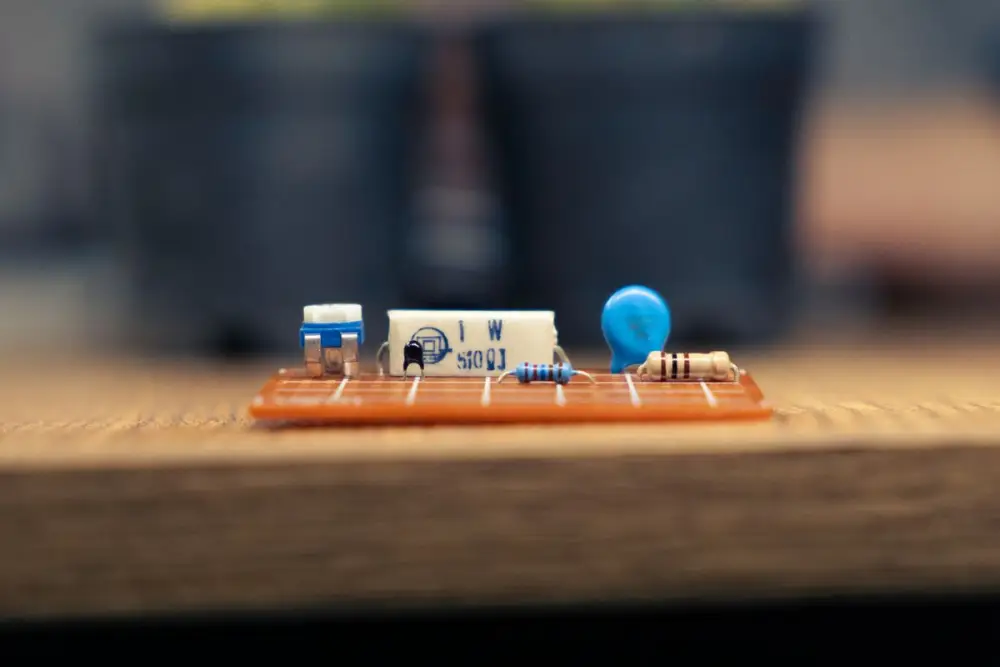
Most through-hole resistors are too small to print a value on, so they use coloured bands. Learn the ten digit colours once and you can read any resistor on your bench. This guide gives you the table, the method and a worked example.
The colour table
Every colour stands for a digit. The same colours also act as multipliers and tolerance marks.
| Colour | Digit | Multiplier | Tolerance |
|---|---|---|---|
| Black | 0 | x 1 | - |
| Brown | 1 | x 10 | 1% |
| Red | 2 | x 100 | 2% |
| Orange | 3 | x 1,000 | - |
| Yellow | 4 | x 10,000 | - |
| Green | 5 | x 100,000 | 0.5% |
| Blue | 6 | x 1,000,000 | 0.25% |
| Violet | 7 | x 10,000,000 | 0.1% |
| Grey | 8 | - | 0.05% |
| White | 9 | - | - |
| Gold | - | x 0.1 | 5% |
| Silver | - | x 0.01 | 10% |
4-band resistors
This is the most common type on cheap carbon film resistors. The bands mean:
- Band 1: first digit.
- Band 2: second digit.
- Band 3: multiplier (how many zeros to add).
- Band 4: tolerance, usually gold (5%) or silver (10%).
Worked example: yellow, violet, red, gold
- Yellow is 4 and violet is 7, so the digits are 47.
- Red as a multiplier is x 100, so 47 x 100 = 4,700 ohms.
- Gold means 5% tolerance.
The value is 4.7 kΩ with 5% tolerance. A 5% resistor of this value can measure anywhere from about 4,465 to 4,935 ohms and still be in spec.
5-band resistors
Precision metal film resistors usually have five bands. The extra band is a third digit, so the value is more exact.
| Band | 4-band | 5-band |
|---|---|---|
| 1 | First digit | First digit |
| 2 | Second digit | Second digit |
| 3 | Multiplier | Third digit |
| 4 | Tolerance | Multiplier |
| 5 | - | Tolerance |
Example: brown, black, black, red, brown. Digits are 1, 0, 0 so 100. Red multiplier is x 100, so 100 x 100 = 10,000 ohms. Brown tolerance is 1%. That is a 10 kΩ 1% resistor.
Which end do I start from?
- The tolerance band is often set a little apart from the others. Put that end on the right.
- Gold and silver are never the first band, so if one is on an end, that end is the right side.
- If you still cannot tell, measure the resistor with a multimeter. Our multimeter guide shows how.
Quick values worth memorising
| Value | 4-band colours |
|---|---|
| 220 ohm | Red, Red, Brown, Gold |
| 330 ohm | Orange, Orange, Brown, Gold |
| 1 kΩ | Brown, Black, Red, Gold |
| 10 kΩ | Brown, Black, Orange, Gold |
| 100 kΩ | Brown, Black, Yellow, Gold |
The 220 ohm and 330 ohm values are common for LED current limiting on a 5 V supply. The 10 kΩ value is the usual pull-up or pull-down in Arduino circuits.
Common mistakes
- Mixing up red (2) and orange (3), or brown and red, in poor light. Use daylight or a torch.
- Reading right to left. Check which band is the tolerance first.
- Measuring a resistor while it is still soldered in a circuit. Other parts in parallel change the reading. Lift one leg first.
- Ignoring power. The bands do not show watts. A 1 W resistor is much bigger than a 1/4 W one.
Where to get resistors in Bhubaneswar
Konark Radio Centre in Ashok Nagar, Bhubaneswar, has been supplying electronic components since 1995. Send the values you need on WhatsApp or visit the shop. If you are building a first project, browse our project kits too.
Frequently asked questions
How do I know which end to start reading from?
Start from the end where the first band is closest to the lead. The tolerance band (gold or silver on most 4-band resistors) sits slightly apart from the others and goes on the right. Gold and silver are never the first digit.
What does a single black band mean?
A single black band, or one black band on its own, marks a zero-ohm resistor. It is just a wire link in a resistor body, used on printed circuit boards as a jumper.
Is the colour code the same for 1/4 W and 1/2 W resistors?
Yes. The colours only give resistance and tolerance. Power rating is not shown in the bands. It is judged from the body size, so a 1/2 W carbon resistor is physically larger than a 1/4 W one.
Can I trust the colours if the resistor looks burnt?
No. A darkened body means it has overheated and its value may have drifted. Measure it with a multimeter out of the circuit, and look for the reason it overheated before fitting a new one.
Need the parts?
Send the parts list on WhatsApp or walk in. Plot No. 39/F, Ashok Nagar, near Sreeleathers, open 10 AM to 9 PM, all 7 days.